


There’s a kind of Christian who is afraid to have fun. Writing his Confessions in the late-390s, the African bishop Aurelius Augustinus (best known to us, of course, as St Augustine) scolded himself for indulging in the ‘vain and curious craving’ of the eyes:
I now do not watch a dog chasing a rabbit when this occurs at the circus. But if by chance I am passing when coursing occurs in the countryside, it distracts me perhaps indeed from thinking out some weighty matter. The hunt turns me to an interest in the sport … shifting the inclination of my heart. Unless you had proved to me my infirmity and quickly admonished me either to take the sight as the start for some reflection enabling me to rise up to you or wholly to scorn and pass the matter by, I would be watching like an empty headed fool.1
The thrill of a wild dog hunting a rabbit was a guilty pleasure, a snatched indulgence, just as the lick of the lips at a portly roast or the way breath escapes one’s lungs at a stunning mountain panorama betrays an unfortunate earthly-mindedness. For Augustine, earthly pleasures must belong to the realm of ‘use’ (uti), not enjoyment (frui): enjoyment must pertain to God alone.
There’s an honesty to this relentless scrupulosity about earthly enjoyments: Augustine was committed to the otherworldly call of Christianity shaping his life in the round. ‘Set your mind on things that are above,’ the apostle writes, ‘not on things that are on earth.’ The Christian, in this tradition, must be monastically-minded, pursuing a rigorous contemptus mundi, a delight in the Jerusalem that is above, ‘with milk and honey blessed’. This ephemeral world, compared to the eternal, changeless world of the heavens—and here you can hear the Platonic inflection that has shaped, for better or worse, so much Latin Christian thought—is clogged with temporality, melded by constant change, marred by a fallen humanity and a broken cosmic order. Christians are men and women of the world to come, citizens of the heavenly city, the only place of true peace and justice.
A similar kind of otherworldliness has at times waxed strong in Protestant thought, too—usually when churches have faced persecution, and confidence about the transformative power of the gospel in this life ebbs low. Sometimes there is something very Augustinian to this, a strain of authentic otherworldliness best preserved in the smile-free presbyterian theologians of the twentieth century. But usually there is a dishonesty to the Protestant variety of contemptus mundi, a dishonesty we might call ‘secularism’. The otherworldly Protestant of the modern era is not a latter-day Bernard, squirreled away with his Cluniac bandits, lobbing thick satires at the institutional church while sighing all the while for urbs Syon aurea. Instead he divvies up his joys and delights: those of the next world, and strictly the next, belong to God, while there is nothing theological, doxological, or frankly at all related to the divine about his earthly enjoyments.

In his novel Jayber Crow, Wendell Berry captures this contradiction with his usual wit. The local barber Jayber, the titular character, is reflecting on the many preachers that come and go from the small Kentucky town of Port William. Their preaching seems so out of tune—not merely with the rhythms and joys of life in the rural South, but with the preacher’s own joys too:
While the wickedness of the flesh was preached from the pulpit, the young husbands and wives and courting couples sat thigh to thigh, full of yearning and joy, and the old people thought of the beauty of the children. And when church was over they would go home to Heavenly dinners of fried chicken … And the preacher and his family would always be invited to eat with somebody and they would always go, and the preacher, having just forsworn on behalf of everybody the joys of the flesh, would eat with unconsecrated relish.
But if the preacher has had to denounce such fleshly joys, and if he loves nonetheless his fried chicken, then he must live with a continual cognitive dissonance, attributing the good gifts of this world to some fallen, godless order that is passing away. If he is thankful for his Sunday lunch, he is not thankful to God. God and his gifts have been evacuated to heaven, to the future, to some amorphous ‘spiritual’ realm where they are, in the context of explicitly religious activity (‘quiet times’, contrived conversations over coffee, church services) pursued with a particular kind of enjoyment.
But that is not the God of the Scriptures. In the primal prayer of the Christian life, we call upon our God to usher in his kingdom here, on earth, as it is in heaven—and this is not, as I have elsewhere argued, merely a prayer to hasten the coming Parousia. God’s ‘realm’ cannot be a future, merely heavenly, ‘spiritual’ reality: the very real disjoint between heaven and earth that we feel so keenly, and that is reflected in the tense paradoxes of our pleasures, is not one we should make our peace with. We must long for the union of heaven and earth, and we must seek it. ‘He comes to make his blessings known / far as the curse is found.’
Faced with those who would deny the godliness of marriage, the apostle Paul is indignant. These proto-Gnostics (to use an anachronism), ‘who forbid marriage and require abstinence from food that God created’, are those who have ‘depart[ed] from the faith by devoting themselves to deceitful spirits and teachings of demons’. Against them, the apostle insists upon the glorious goodness of God’s created order:
For everything created by God is good, and nothing is to be rejected if it is received with thanksgiving, for it is made holy by the word of God and prayer.2
Is this contempt for the world? In a sense: this enjoyment of God’s created gifts begins with an immersion in the Word and in prayer that is foreign to the world. For ‘to the pure all things are pure’, and it is with a purity that marks one out from the world that true enjoyment must begin. And yet it turns its gaze upon the world, upon all that God has made, with the intensity of a holy enjoyment—a delight that the goodness of creation, of the world that we experience, has been vindicated by the revelation of the giver, by finding that our innate impulse to give thanks for all that is good has at last found a home, a telos, and a repose.
And this means, pace Augustine, that God is fun. For the world is fun: it is full of enjoyment, full of quiet delights that are utterly ‘irrelevant’, whose only real explanation can be that God is—far more than we are—bursting with a kind of exuberance that we, in all the cynical wisdom of worldly ‘maturity’, usually account the remit of children. Psalm 104 bursts with this divine exuberance. There the psalmist celebrates the God who has
cause[d] the grass to grow for the livestock
and plants for men to cultivate,
that he may bring for food from the earth
and wine to gladden the heart of man,
oil to make his face shine
and bread to strengthen man’s heart.3
And it isn’t just mankind to whom God has given great joys. Even the frightful beasts of the sea (the symbol of chaos in Judaic thought!) express the wonder of God’s creating pleasure:
Here is the sea, great and wide,
which teems with creatures innumerable,
living things both small and great.
There go the ships,
and Leviathan, which you formed to play in it.4
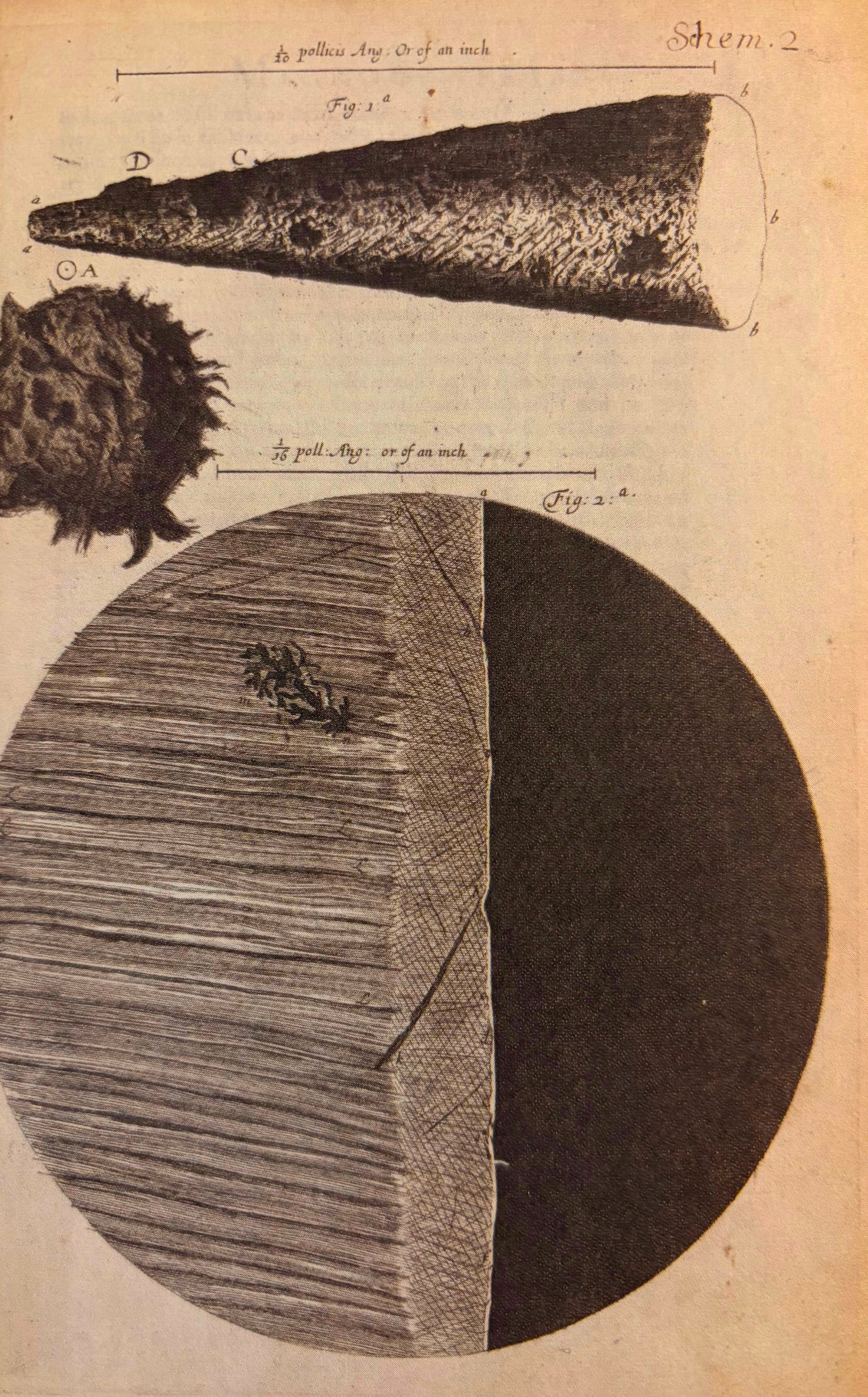
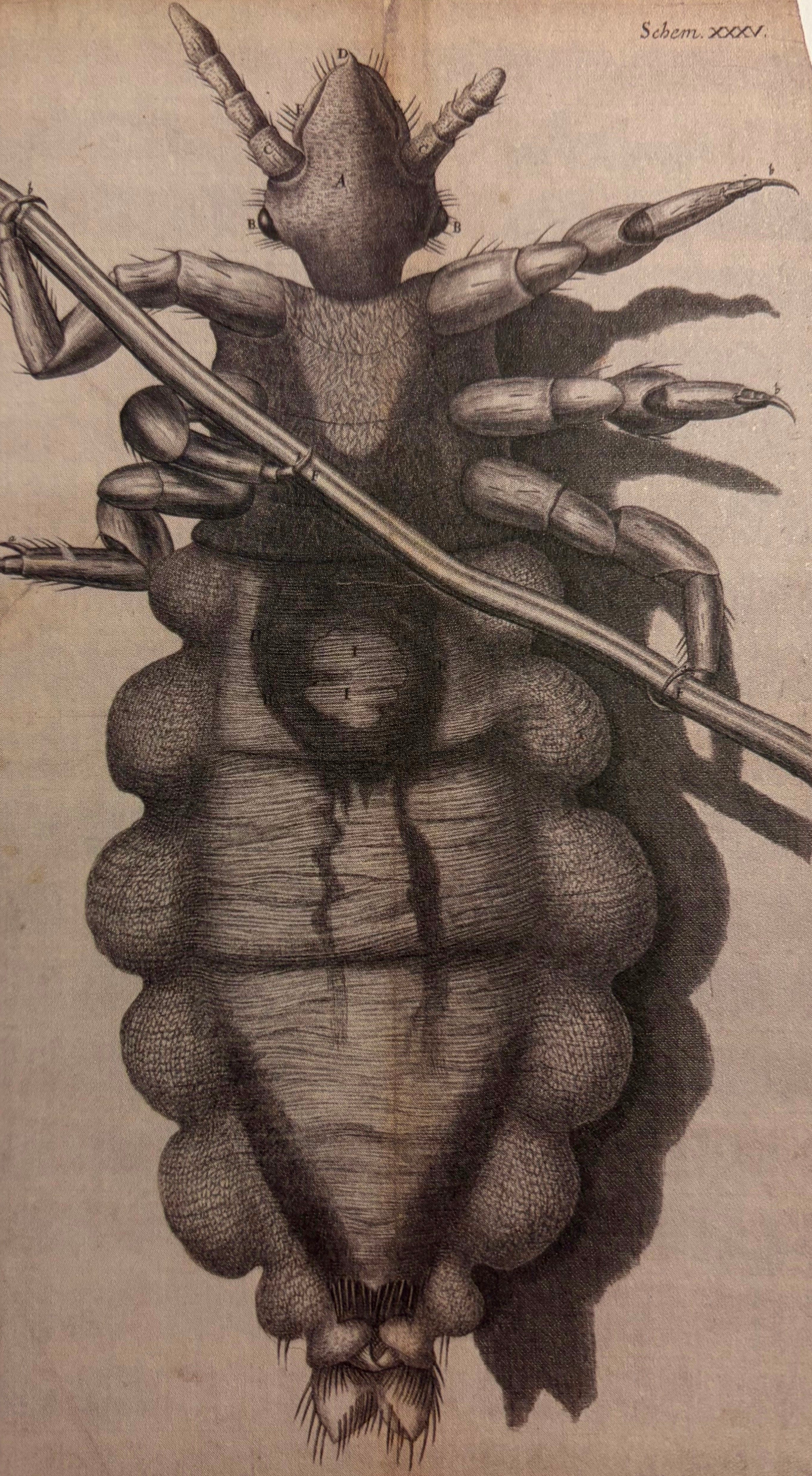
The great creatures of the natural realm betray the glorious truth that God has made this world out of an abundance of pleasure, of holy fun. But when the natural philosopher Robert Hooke (of Hooke’s Law fame) first looked down a microscope, he discovered that the same was true—perhaps even more true—at those tiny planes of existence that for millennia were hidden from human view, but which he made visible to the reading public in his Micrographia (1665). Viewed through the illuminating lens of the microscope, the intricacy, beauty, order and inventiveness of divine artifice so clearly outstripped the feeble creations of man: a full stop, a needle tip, or the edge of a razor are at best fuzzy, messy, imprecise when set alongside the compact exoskeleton of a head-louse.
God, said Chesterton, ‘has the eternal appetite of infancy’. He never grows tired of the joys of creating, of calling afresh the sun into its dawn or the daisy from the seed, day by day, season by season, like a child yet to assume the jadedness of age, calling upon their parent to ‘do it again’, and again, and again. While ‘we have sinned and grown old’, ‘our Father is younger than we’:5 and we see this divine youthfulness everywhere we look. What else but the innocence of youth could create the Adonis blue, a butterfly whose larvae must be ‘milked’ in the underground nests of ants who carefully harvest their honey-like excretions? It is the eternal agelessness of God, his perfect freedom from jadedness and cynicism, that keeps the stars in the sky and the seasons rolling by, that sees to it that the earth teems with the vibrancy of a beauty that human inventions can scarcely imitate. ‘Consider the lilies of the field, how they grow: they neither toil nor spin, yet I tell you, even Solomon in all his glory was not arrayed like one of these.’
Conf. X.35.
1 Tim. 4:4–5.
Ps. 104:14–15.
Ps. 104:25–26.
Chesterton, Orthodoxy, pp. 151f.