


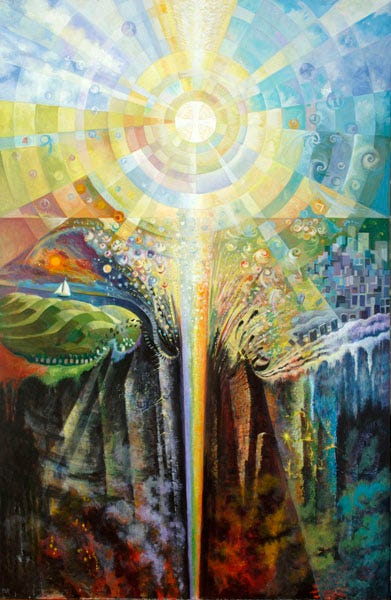
Jesus' resurrection, the great event we remember and celebrate today, is - among innumerable other wonderful things - the great affirmation of cosmic justice. It is God's verdict on the man whom men accused of blasphemy and lies. They executed him in the most shameful way possible, hung on a cross for all to ridicule. God vindicated him in the most glorious way possible, raised from the dead for all to worship. Those charges, says God, were lies. This man was no blasphemer. This man was no liar. This man was no criminal to be executed. And so man's judgement was overturned by God's judgement, in an utterly unique correction of injustice. For sure, we sometimes see falsely accused prisoners released by our governments and courts. But falsely executed ones are much harder to release.
Here as well is the great confirmation of all God's promises. Promises like:
‘Tell the righteous that it shall be well with them, for they shall eat the fruit of their deeds.’1
‘Keep far from a false charge, and do not kill the innocent and righteous, for I will not acquit the wicked.’2
‘Behold, his soul is puffed up; it is not upright within him, but the righteous shall live by his faith.’3
‘For you will not abandon my soul to Sheol, or let your holy one see corruption.’4
‘Treasures gained by wickedness do not profit, but righteousness delivers from death.’5
These promises and proverbs were not bluffs, nor were they true ‘in general’, as if the sense of them were, ‘Do good and it will go well for you most of the time, except when it doesn't’. No, God is the protector of the righteous. He does not punish the innocent, just as he doesn't acquit the guilty. The resurrection shows that the righteous man will truly live. The one who keeps God's commandments shall not taste death forever, but punches through death into eternal life.
Until Christ, no-one had put these promises to the test. Before him, no-one could sincerely claim to be without sin, or undeserving of wrath and death. Of course there had been many miscarriages of human justice, and examples of people suffering when they did nothing in particular to deserve it. But in the cosmic courtroom, whether pagan (or atheist) worshipping many gods (or none), replacing the creator of the universe with created things (or attempting to remove him entirely), or monotheist claiming a zeal for God whilst breaking his commands and bringing dishonour to his name, all are guilty. No one is righteous, not even one. No human prior to Easter could complain that God had failed to keep his side of the deal, because they had failed their side of it first.
But when a man came along who lived a truly perfect life, who did nothing deserving of death, yet was murdered anyway, God delivered him.
That God saved Jesus is confirmation that the righteous shall live. Conversely, that Jesus was raised from the dead is confirmation that he was truly righteous. It is not just God's justice that is vindicated at the resurrection, but Jesus himself; his personality, character, way of life, teaching, and mission. The righteousness of God the judge, and the righteousness of Christ the judged, are both on display. If you want to know what a truly righteous person looks like, look to Christ. If you want to know the sort of life that is worthy of glory and honour and immortality, look to Christ. If you want to know what it means to be truly human, in the way God intended, in the likeness of his eternally begotten Son and in contrast to what Adamic humanity has become, look to Christ. This is what righteousness looks like. He is what righteousness looks like.
On its own, this might lead us to despair. It is possible to live a life worthy of life, but of the countless billions who have been and gone, only Christ has managed it. Then what hope is there for us? The hope, of course, is in Paul's great reworking of Habakkuk's promise. Not just that the righteous shall live by faith, but that ‘The one who by faith is righteous shall live’. If we believe the message of Easter, that Jesus Christ was raised from the dead, is alive and reigns now as Lord of all, then that faith is counted to us as righteousness. If we trust in the man who was perfectly righteous, we share in that righteousness. And Jesus’ resurrection assures us that if we are righteous, we will certainly live. Because God will not let his righteous ones be falsely accused. They will not see decay. Instead we share in Christ’s life, and rule, and glory.
Jesus lived, died, and was raised in such a way as to bring us poor sinners along with him. We are united to him in his death and resurrection. Jesus is declared Christ and Lord in a way that brings salvation, not judgement, to those who were once his enemies.
But there is one more link in the chain. One more step needed to vindicate his name, and divine justice. For ever since that first Easter, there has been a cover-up mission, a counter-operation seeking to obscure God's verdict and perpetuate lies about Jesus. A mission seeking to hide the risen Christ, to claim that he's still dead, that man's verdict was final, that he was just a sinful man like any other after all.
This is seen most clearly in Matthew's Gospel. After his death, Jesus’ body was covered up in a tomb. The body of the Son of God sealed away, never to be seen again. That cover was then blown away as the sealed tomb was blasted open and his resurrected self walked the earth. But still the leaders of the temple tried to cover up the resurrection, asking the soldiers to claim that the disciples stole the body, and promising to pay off anyone that would cause them trouble as a result of partaking in this conspiracy. But then Jesus appears to his disciples on a mountain, is worshipped, and commands them to go to all nations with the news of his resurrection, to make disciples from every corner of the world. The cover up cannot be given the last word. The truth must be known. Jesus’ resurrection life must be uncovered and revealed to the whole world.
Global mission is the great vindication of Christ in the world, as more and more people learn the truth that he really is the Son of God, who reigns forever, and are baptised into his kingdom. It is also the great vindication of God's justice. In verses already alluded to, Paul says the following about his own mission to preach the gospel to the Gentiles: ‘For I am not ashamed of the gospel, for it is the power of God for salvation to everyone who believes, to the Jew first and also to the Greek. For in it the righteousness of God is revealed from faith for faith, as it is written, “The one who by faith is righteous shall live.”’. In the gospel, and in gospel proclamation, the righteousness of God is revealed. This phrase is probably deliberately ambiguous. Yes, wonderfully, a righteousness from God is revealed, a righteousness imputed to sinners. But the gospel also reveals the righteousness of God; his goodness, justice, judgement, mercy, and plan to extend his mercy to people from every nation through Jesus Christ, in a way that is still just. As the gospel is proclaimed to all the world, God's cosmic justice is revealed, and the true verdict on Jesus Christ is made known to all.
So we must continue to ponder the message of Easter for ourselves, and praise and proclaim Christ among the nations. We, and the world, must know that Jesus' death was not the final word. That the executed ‘blasphemer’ has been vindicated as the eternal Son of God, a righteous man, worthy of life. That God, in his divine justice, could not let such a man go falsely accused and wrongly executed. Could not let him stay dead. So if you want to live, trust and follow him.
Happy Easter, from the four of us at Sacramentality!
Christ is risen!
He is risen indeed; hallelujah!
Isaiah 3:10
Exodus 23:7
Habakkuk 2:4
Psalm 16:10
Proverbs 10:2