


Over the past few years, I have slowly been learning Greek, and my latest exercise has been reading through St John’s gospel. The effort of comprehension, puzzling over individual words then piecing them together into sentences, often obscures the wider meaning. But occasionally, like a pearl diver breaking through the surface of the water for breath, treasure in hand, I stop and am able to see the wonder of the words I am reading, only made more wonderful because they have appeared out of the depth of those strange symbols. Thus, ‘Ἴδε ὁ ἀμνὸς τοῦ θεοῦ ὁ αἴρων τὴν ἁμαρτίαν τοῦ κόσμου’ becomes, ‘Behold, the Lamb of God who takes away the sin of the world’, and for a moment I do behold the suddenness of Christ’s redemption, as the cosmos is transfigured by forgiveness.
Another pleasure of translation is when connections are visible with English words. I remember first coming across the word θησαυρός; I had no idea what it meant, but I could transliterate it to get thesaurus. How wonderful, when I looked it up and saw that its meaning was treasure-house, so that every time I choose a word I am delving among jewels.
Or consider the word γραφω (graphō), meaning I write – hence we have the words autograph for one’s own writing, and cryptograph for hidden writing. The biblical authors use it to refer to Scripture, either as a noun or in the phrase ‘it is written’. There is something about the word which conveys the physical act of writing, emphasising the words as we see them written on the page, ink on paper, almost before we think of their meaning. Indeed, this sense is present in our English word scripture – think about the very tactile process of inscribing something.
Physical writing has both a uniqueness and a longevity; this is the power of a signature, to declare that this statement stands, exactly as it is written here on this piece of paper, for as long as the paper survives. I love to write by hand. My notebooks exist in a way that no computerised document does, and they bear all the marks of being mine: every scribbled idea, crossed out thought, change in the neatness of my hand. I will keep them long after the electronic versions have been lost amongst the countless ones and zeros of which they are made.
When God gave his law to Moses, he chose to write it in the most physically enduring way imaginable, carved in tablets of stone. This, exactly as God himself wrote it, was what Israel was always to obey. We can learn much by contemplating the oral traditions of scripture, but there is a steadfastness in its written aspect, in the permanence of every iota, which we should remember.
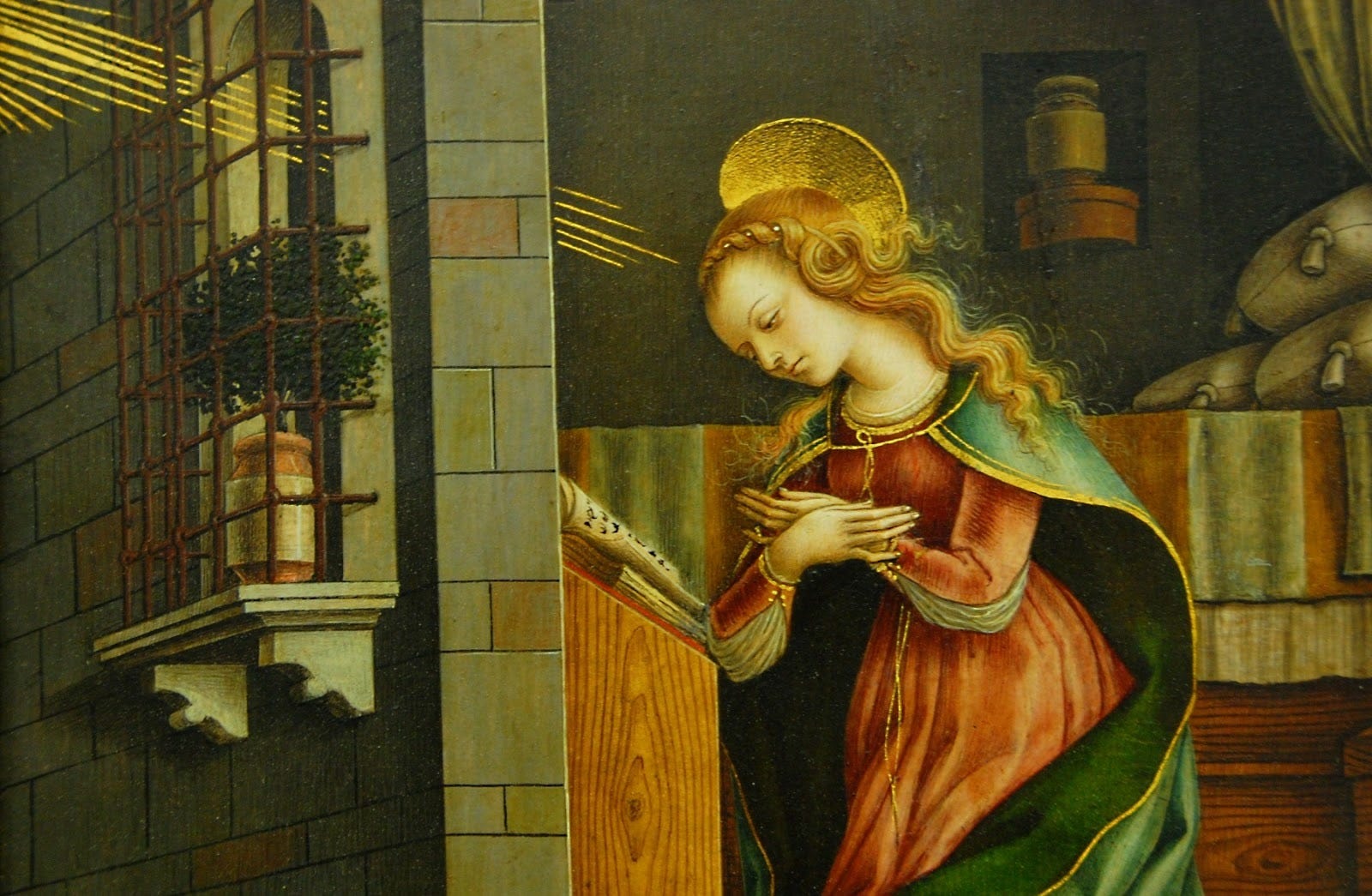
As we celebrate the Annunciation this week, consider Hannah’s song in 1 Samuel 2, and the unmistakeable way in which Mary parallels it with her Magnificat. These words were first sung, but then they were written down and that scripture was passed across the generations, so that when an angel turned a young woman’s world upside down she could turn to those familiar lines. Paintings of the Annunciation usually picture Mary in the midst of reading; when the proud were scattered in the imagination of their hearts, and the mighty put down from their seats, she was well-prepared to trust that just as those words of God’s faithfulness were true when written centuries ago, so they were true for her now when all else was changing.
In the same way, when I am embattled by sin, within and without, I know that it has been written that there is a Lamb of God who takes away the sin of the world. These are not words I have dreamed up – they are not even of my own language, let alone my fashioning. They are an assurance outside myself, an eternal truth to be discovered like feeling words carved into a rock. I used to teach a student who was completely blind, and watching him read braille was mesmerising – it was his means to escape the darkness and encounter the rich and concrete world of symbolism. For all of us, the written word can be a means to step outside of ourselves and escape the ethereal realm of endless introspection.
Scripture also bears all the marks of human writers who had experienced God’s faithfulness. Even the translations we use today are alive with the unique personalities of the authors. There are the humorous details when God’s enemies are defeated; the exclamations of praise in the Psalms; the beautiful references to ‘the disciple whom Jesus loved’ in John’s gospel; and the everyday practical requests in the epistles which tell how God worked wonders through humble men. Again, this is even clearer when reading in the original language. One cannot escape Paul’s excitement in Colossians 1 as his clauses roll on and on to the glory of Jesus Christ, a peal of hymnody to the redeemer of the cosmos.
On a different note, think of the classic children’s song: ‘Jesus loves me, this I know/for the Bible tells me so’. If this was the sum of our faith, we might have a problem – I know Jesus loves me for countless reasons: because of the unchanging nature of God, because of the Spirit dwelling within me, because of the death of Christ himself upon the cross. But there is something wonderful about those lines. When everything is thrown up in the air, when I am alone in an abyss of questions, when the writing on my heart feels very faint, I have a book on my bedside table, the words of which – ink, printed on paper – have never changed, nor has their truth, and nor has the God who wrote them. I have a treasure-house which I can read and say, ‘Yes, Jesus loves me.’