


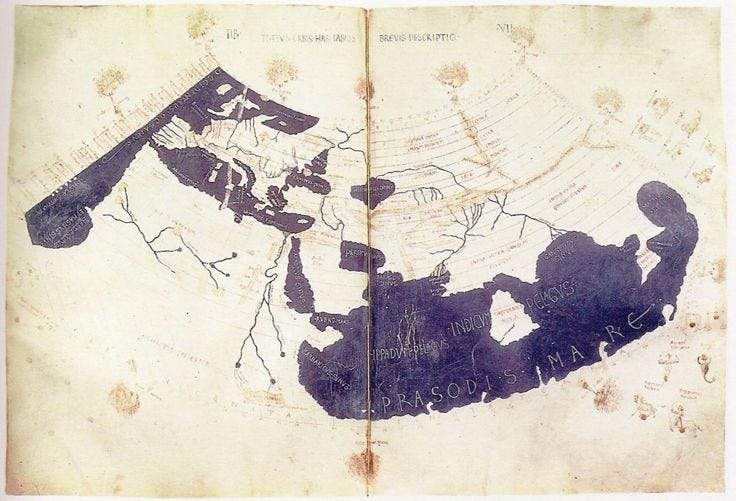
…In that Empire, the Art of Cartography attained such Perfection that the map of a
single Province occupied the entirety of a City, and the map of the Empire, the entirety
of a Province. In time, those Unconscionable Maps no longer satisfied, and the
Cartographers Guilds struck a Map of the Empire whose size was that of the Empire, and
which coincided point for point with it. The following Generations, who were not so
fond of the Study of Cartography as their Forebears had been, saw that that vast Map
was Useless, and not without some Pitilessness was it, that they delivered it up to the
Inclemencies of Sun and Winters. In the Deserts of the West, still today, there are
Tattered Ruins of that Map, inhabited by Animals and Beggars; in all the Land there is
no other Relic of the Disciplines of Geography.
—Suarez Miranda, Viajes devarones prudentes, Libro IV,Cap. XLV, Lerida, 1658
Jorge Luis Borges, On Exactitude in Science
Maps or Reality?
Baudrillard coined the term ‘hyper-reality’ to describe a world where the representation mattered more than the reality, such that the reality became impossible to find. He refers to this fable by Jorge Luis Borges, where a map is drawn in such fine detail it becomes an exact replica of the empire it depicts. In the fable, remnants of the map flutter about in the furthest corners of the desert for millennia afterwards. Baudrillard suggests that in modernity our maps of reality (‘simulations’) have remained while reality itself has increasingly dissolved. The emergence of mass media, new technologies and multiple meta-narratives together untether images from realities, until the ruins of reality exist like some lost city, and most of life is lived in the ‘desert of the real’.
Baudrillard’s hyperreality helps decipher some of the current discourse around masculinity. The manosphere depicted in Louis Theroux’s new Netflix documentary may seem absurd to the casual viewer. The ‘hypermasculinity’ of men like the Tate brothers, Myron Gaines, or HStikkytokky is self-consciously exaggerated. No-one except a small minority of earnest teenagers thinks it’s manly to puff a cigar in a kimono. I’m not even sure Andrew Tate thinks it’s cool. But in a hyperreal world, appearances matter more than the substance, to the point of detaching themselves from reality, then becoming a replacement for the thing itself.
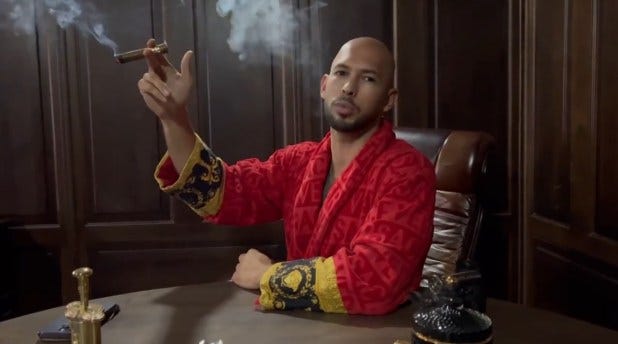
The manosphere is guilty of taking masculine symbols like wealth, status, fecundity, and power, confusing them for the essence of masculinity, then repackaging them in a bastardised form. Consider, for instance, how Tate made the money that allows him to pose with flashy status symbols like fast cars. He essentially created an early, non-consensual form of OnlyFans. With this money, he started a course called ‘Hustlers University’ where young men would learn the art of dropshipping and investing in crypto. It reeks of degeneracy, a far cry from the great men of history he seems to admire. The core difference between Tate and the men he wants to imitate is that Tate’s entire life is performed for an audience, and is therefore aesthetically oriented. He focuses on visible status symbols as ends in themselves, forgetting that they derive their value from deeper realities, or as means to higher ends.
Similarly, if you watch influencer HStikkytokky in the Theroux documentary, his persona is unwavering, even as he blatantly contradicts himself. Theroux several times challenges him on saying one thing and doing another, or simply saying two opposing things, but after a brief moment of cognitive dissonance HStikkytokky ploughs on. He is a man who will allow no compromise or defeat, because to be corrected is to be humiliated.
As an influencer who relies on his followers, he has no guiding principle for his life beyond how he presents to his followers. In one exchange, a boy comes up to greet HS and Theroux comments on how young his fans are. HS agrees - it is weird that 12-year-olds are seeking his advice on how to be a high-value male. But as his audience, he is ultimately beholden to them. HS smiles and poses for a photo with the boy.
Manosphere men are purveyors of premium-grade nonsense: they sell pyramid schemes which guarantee they will become richer at the expense of their followers; they profit from sexual exploitation while condemning the loose morals of modernity; they boast about their sexual promiscuity while enjoying the benefits of monogamy; most of it is a barely concealed lie and they know it. They are profiting from a world where the essence of masculinity has been replaced by a growing hyperreality, at which point the symbols hold as much weight as what they were initially representing.
Gender Histories
The detachment between gender symbols and gender realities is chiefly the result of centuries of material changes in economics and technology. For most of history the value of men was demonstrable: they were physically stronger than women, and not confined by strict biological limits. This meant they could work harder, for longer, without interruption. Men and women had their own spheres of work, from which came identity. Women largely took on home-based roles which could fit around children, such as sewing, mending, cooking and cleaning, while everything else from hard labour to craftsmanship and knowledge work was primarily male. Even where men and women performed the same tasks, such as harvesting crops, they used gendered tools: for instance, women’s scythes had different handles, to reflect a difference even within the same task. Thus there was always differentiation and each gender had a discrete sphere. Symbols signified reality.
In the division of male and female labour historically the male sphere of work is defined by the female one, not the other way round. This accorded great dignity to both spheres. The building block of society is the family, and the family exists to provide stability for mother and child, in order that the human race can continue. Childbirth and rearing is a risky, costly, and intensive enterprise, relying on social order and delayed gratification, an order which stems from the husband in his role as protector and provider. As this pattern replicates, nascent society emerges. Society is itself a simulacrum of the family unit; the social contract takes its cue from the marriage contract, where the stronger party promises to protect and provide for the weaker, for the sake of the common good. Therefore, gendered roles were the building blocks upon which society flourished.
But as progress rolled on the industrial machines emasculated men, robbing them of physical power; two world wars moved women into the workplace, then the rising costs of housing and childcare kept them there; the development of contraceptive and sanitary products created new agency for women; and the service-based information economies, at least in the West, levelled the professional playing field. Meanwhile, IVF promised the possibility of children later and later in life, while new critical narratives emerged in this fertile soil, questioning the traditional spheres of masculine and feminine roles.
It was natural for these critical narratives to emerge; typically they came from focusing on the increasingly outdated map of gender scripts, a map which was never reality itself. In times of revolution, iconoclasts gleefully tear down whatever they can get their hands on, and so this map was also torn apart. We now sit in a time of tattered reality and tattered symbols, wondering where to go next.
Modern masculinity discourse is sometimes a critique of these traditional gender roles, and sometimes a doubling down on them, or a misreading of the symbols. The material landscape has changed faster than our minds or bodies can adapt, producing deep-seated inadequacy and confusion for men in particular.
Maps after Reality
If we are now more focused on the representations of masculinity than on masculinity itself, it’s not surprising we have several, related narratives emerging. Looksmaxxing (looks-maximising) has finally hit mainstream media: a meme-y name for a meme-y phenomenon (for a meme-y society, as T.J. Holland detailed in his recent article), where men use a combination of natural, bizarre and invasive methods to become as attractive as possible.
Tactics range from going to the gym and implementing a strict skincare routine (sensible), to the use of unconventional weight loss drugs like crystal meth (questionable), to bashing a trophy against your cheekbones so when they swell they look more attractive (painful). The rating system is harsh: Spiderman actor and Hollywood star, Tom Holland (not to be confused with the historian, or our fellow writer at Sacramentality), widely considered a good-looking man, receives a 4/10 rating on the looksmaxxing forums.
The methods are promoted by a community of influencers led by the king himself, Clavicular. Clavicular boldly goes where others dare not follow: he is functionally sterile from his steroid use, and currently considering life-changing surgery to add four inches to his height (from 6’2 to 6’6). He is quite autistic.


The media is unsure how to treat looksmaxxing, so it is often lumped together with the wider manosphere. Both have their fair share of rabid, misanthropic content. Both are obsessed with self-optimisation, to increase one’s value in the dating marketplace. Both are aimed almost entirely at young men, and both ultimately seem more interested in male status games than the functional rewards of female attention.
However, these similarities can mask very different economies in the two worlds: where the traditional manosphere is concerned with wealth, women and fast cars, the looksmaxxing world has the singular currency of looks. Indeed, debate rages in these forums of whether Andrew Tate is even a high-value male (based on his looks). In an interview last year, Clavicular described the renowned liberal Governor of California Gavin Newsom as a ‘Chad’ for his good looks, and arch-conservative Vice-President JD Vance as a ‘subhuman’, on account of his diminutive stature and weight around the belly. Looksmaxxing is post-political, subsuming politics into its economy.
The real overlap between looksmaxxing and the manosphere is their performativity. They have latched on to one, or a few, signifiers of masculinity, and pushed them to an extreme. And not only that, but they have identified visible, aesthetic symbols of masculinity which they can parade. There is a fragment of masculinity - the desire to provide financially, or the importance of health and strength - but the representation has become far more important than the thing itself. We are in the era of the performative male.
The term ‘performative male’, if you are online enough, may conjure up tote-bag wielding, matcha-sipping, dungarees-wearing, Virginia Woolf-reading urban males, while the manosphere may imply the opposite: macho men driving Ferraris, smoking cigars and trading crypto, but they are only shadows of each other; two sides of the same horseshoe. One version of the performative man exaggerates his maleness, while the other extreme needs to signify the opposite: in the face of a hyper-masculine onslaught, he doubles down and pursues the softboi aesthetic to show his solidarity with women, performing for them instead.
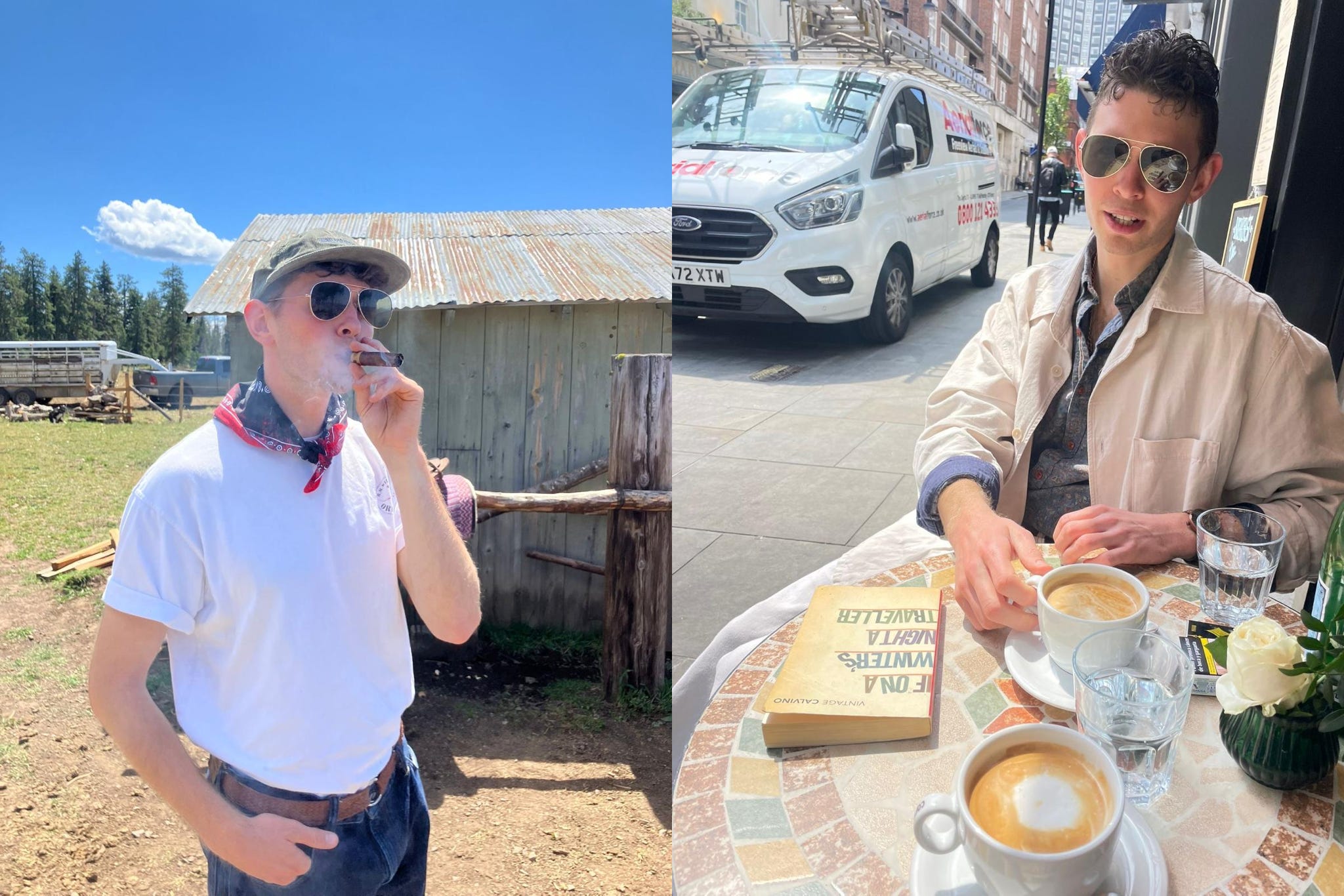
Both the softboi and the manosphere guru are deeply performative. Some men declare there are too many feminine men and perform an aggressive masculinity, others tut and shake their heads at the overcompensation of the manosphere then pull on a pair of jorts. There are more ways than ever to define and express masculinity, from the stereotypical to the subversive, but each feels more like a charade than the thing itself.
Post-Reality Performativity
The early manosphere developed a significant spin-off movement called ‘MGTOW’ (men going their own way), where disenfranchised men distanced themselves from women altogether. The MGTOW crowd felt that modern society demanded too much from men: to continue providing essentially masculine roles, without the incentives or status that traditionally came with masculinity. Nihilism rarely lurks far below the surface of masculinity movements, whether the men are chasing status, improving their looks, or lamenting the decline of exclusively male spheres. However, there was something noble, even if misguided, about their attempt to live life on their own terms, without reference to women or status.
Conversely, the modern manosphere’s success is almost exclusively defined in relation to sexual market value. But the culmination of economic and technological consequences which diminish men’s roles as protectors and providers increasingly means the pursuit of sexual value as an overt status symbol, and status is as much an intra-male performance as a performance to women. The pop-evolutionary psychology narrative goes that in times yonder, alpha males would have hundreds or thousands of women in their harem, or they’d do a Genghis Khan and impregnate whole villages. But because they either cannot achieve this, or do not want to, the modern alpha male boasts of his sexual conquests when they amount to, at best, sleazy affairs in Marbella or Dubai. It is a far cry from his ancestors.
Clavicular cannot even have children because he is sterile, and most women would find his obsessive pursuit of looks off-putting. Even the premise of ‘mogging’ (showing someone up with superior good looks) is an intra-male competition. These men have made the thrill of the hunt their goal, forgetting there should be something to show for it.
Similarly, the performative male acts, implicitly or explicitly, for sexual attention of a kind, in signalling that he is not like other guys. The aesthetic becomes simply one more way of increasing value, while his status symbols are oriented around tastes and habits (reading novels, only listening to music through wired earphones, etc.) rather than the overt, flashy objects of the manosphere.
In each of these instances, a trend latches on to a truth (of what women value, or what distinguishes men from women), but takes it to an extreme, looking for some heuristic by which masculinity can be measured. However, a concept as slippery as masculinity will never lend itself to a single measure, nor can it be reduced to a series of characteristics. The hyperreal distracts us from recovering the reality itself.
Walking in the Desert
So where does this leave the modern man? In previous eras the maps corresponded to the real, and by studying the symbols men could learn about healthy masculinity. In an old world when women were maidens and kings fought in holy wars, knights were fitting symbols. When the old world sat fresh and unconquered, cowboys and explorers were performative males in the right ways, instilling a sense of adventure and romance. Through most of history in most places, nature was harsh and relentless so men had to be strong. In our new world, new types of masculinity are required. Short of a world war or a similar global catastrophe that reverses material progress by centuries, it is hard to imagine a return to the traditional narratives.
In the ‘desert of the real’, hyper-masculinity will continue to abound. It may be criticised, but without an understanding of where our particular map of reality came from, and therefore where it falls short, it is hard to offer an alternative. Neither map nor reality will be reconstructed overnight, so it is good to sit among the ruins for a time, recognising that our culture is lost. We lack the tools, language or framework to craft a modern masculinity.
The next step, especially when in the desert, is to look up. The night sky becomes clear and we can finally feel our smallness. By looking up, we already escape the bounds of a two-dimensional map. A man’s horizons can move beyond the horizontal, material goods of looks, status and wealth, knowing they cannot be guiding principles for the good life. Self-improvement is noble and necessary, but far more important is to escape the bubble of ourselves. Look up and see the cosmos, then feel small for a time. Upon your return, things start to find their proper place.

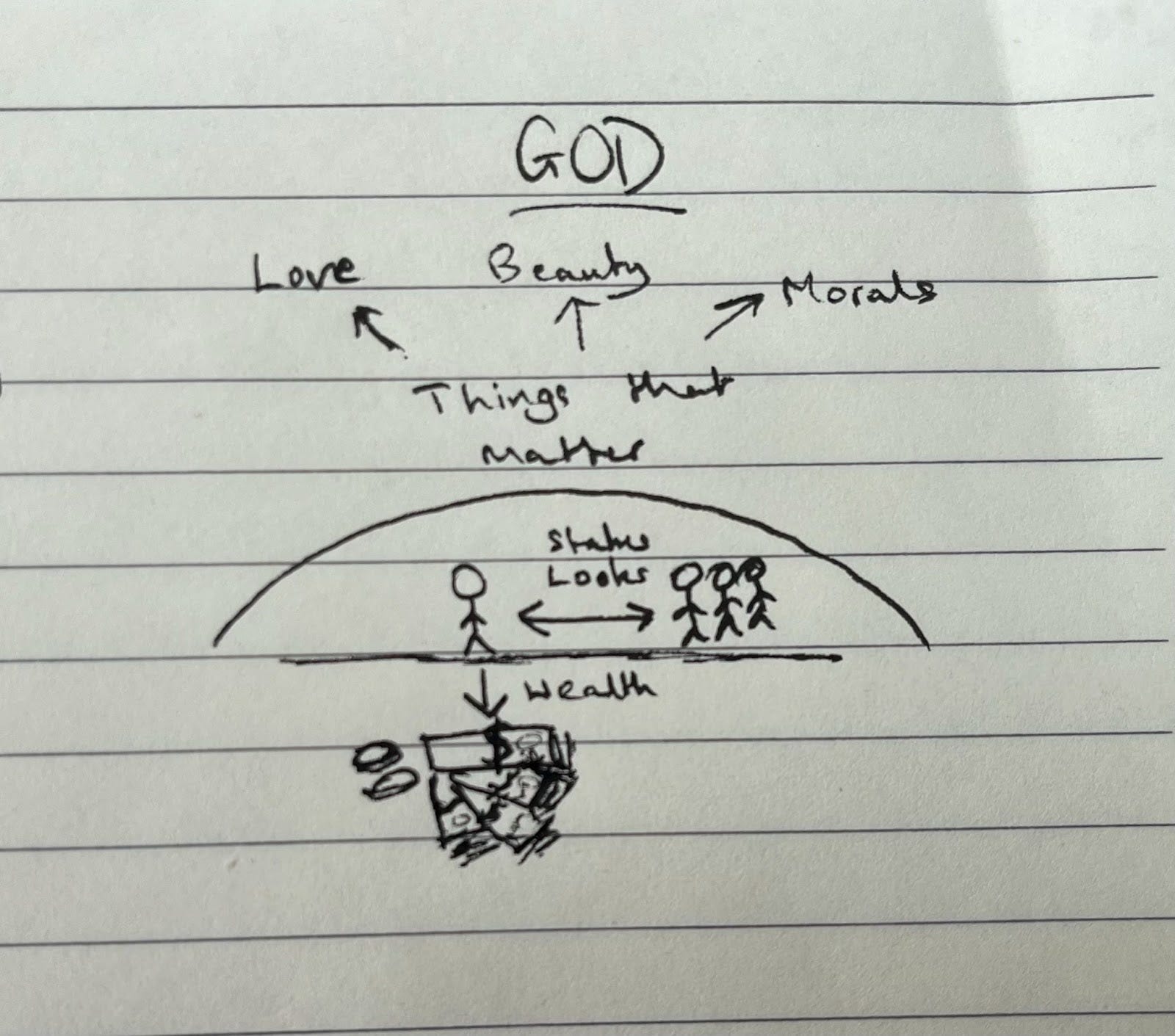
When you look up for long enough, you realise there is order, and our symbols of masculinity are not masculinity itself. They are guilty of exaggerating or diminishing the truth. Of course looking good matters, wealth, health and status matter, but they do not define masculinity, or flourishing generally. They are goods which primarily derive from the opinion of others, therefore they anchor us in the horizontal world and stop us from reaching the heart of reality.
At the heart of reality is an encounter with the Uncreated Creator who orders the whole world, including us and our gendered identity. This does not tell us everything about masculinity, but it gives us the confidence to move forward, knowing there is something real at the heart of all this. Answers won’t come straight away, and we will need to return to the world of the everyday to start creating an answer, but in this cultural moment we must first pause and contemplate.
The tools for the modern man therefore, are contemplation and adoration. Contemplation as he looks up, then adoration as he loves the true order of things. From contemplation and adoration flow wisdom and joy, which ought to be the hallmarks of everyone serious about finding their place in the world. Together, they break the need for performance, because they are not dispositions of striving. The old scripts are gone and man must write his story afresh, but from a place of confidence, knowing he is not tracing contours with his thumb but climbing the mountain himself. The old maps of the world will lead him down the same wrong paths, while the pursuit of reality will force him to ponder how God has created him, as an individual soul and as a man.
Practically, for most men that will look like marriage and children, following the natural desire for responsibility which stems from the God-given mandate to fill the earth. It is a way for men to leave a legacy and be fruitful. This may even mean following some of the manosphere’s advice on how to improve oneself holistically, in order to find a virtuous wife. For most men, it will look like contributing to something of lasting value: committing to a local church, seeking the renewal of a local area, developing a skillset to be fruitful for the world.
For some men, it looks like devoting themselves to religious orders or the academy, where they can contemplate freely. This is not the opposite of action. Thomas Merton writes that “contemplation is the highest expression of man’s intellectual and spiritual life. It is that life itself, fully awake, fully active, fully aware that it is alive. It is spiritual wonder. It is spontaneous awe at the sacredness of life, of being.”
What this new quest for masculinity looks like is for each man to discern based on his time, place and gifts. It is not an easy task, but crucially it cannot substitute symbols for hard realities, or define itself in relation to the female. There is no return to an imagined past, nor is it necessary to exaggerate maleness in desperation. A man’s duty is to sift through the hyper-real, hyper-masculine content and discern what is good, right and true, avoiding parodies and crafting new narratives for masculinity. It is a less glamorous work but the reward is eternal.
A very funny and most heartfelt article.
It strikes me, looking at the diagram you drew of our place relative to God, how much it resembles antiquity's three-tiered view of the cosmos.
As our knowledge of the physical universe increased, the flat earth and vaulted heavens of this older picture gave way to spinning balls and the black expanse of space. Yet I wonder whether this reminds us that we need to return to this vision today, for it held and does hold importance beyond the material and into most other realms — including the moral, the relational, and, yes, the devotional.